C-GPAT – Air Transat Airbus A310: The Aircraft That Lost Its Rudder at 35,000 Feet
At 35,000 feet above the Atlantic, the crew of Air Transat Flight 961 heard a loud bang.
Then the aircraft began to vibrate.
It started rolling from side to side.
There were 271 people on board.
The aircraft was an Airbus A310.
Registration C-GPAT.
The date was 6 March 2005.
Flight 961 had departed Varadero, Cuba, and was climbing north toward Québec City when something extraordinary happened approximately 90 nautical miles south of Miami.
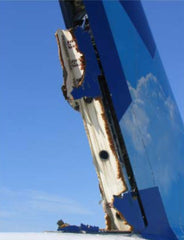
A major part of the aircraft's rudder separated in flight.
The pilots could not see the tail from the cockpit.
They did not yet know what had happened.
They only knew that their Airbus had suddenly begun behaving in a way it should not.
The captain disconnected the autopilot.
The aircraft entered a Dutch roll.
The crew descended.
Eventually, the oscillations diminished.
They turned back toward Cuba.
C-GPAT landed safely at Varadero.
Only after the aircraft was on the ground did the scale of what had happened become visible.
Almost the entire rudder was gone.
Remarkably, this was not the end of C-GPAT.
The Airbus was repaired.
It returned to service.
And it would continue flying for Air Transat for approximately another fifteen years.
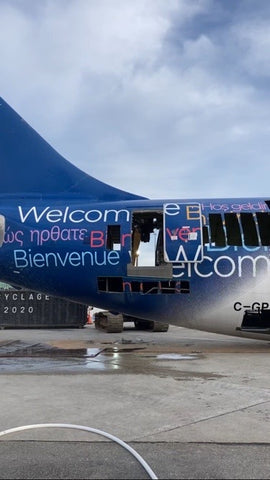
Today, part of its genuine fuselage skin has been preserved by Aircrafttag.
Before C-GPAT – A6-EKJ
The aircraft was built as an Airbus A310-308 with manufacturer serial number MSN 597.
During production and testing, it carried the Airbus test registration F-WWCU.
The aircraft was powered by two General Electric CF6 engines.
But C-GPAT was not its original identity.
Its first airline was Emirates.
In August 1992, the new Airbus A310 was delivered to the Dubai-based carrier as A6-EKJ.
At the time, Emirates itself was still a relatively young airline.
It had begun operations only in 1985.
The enormous global network and fleet of Airbus A380s and Boeing 777s associated with Emirates today did not yet exist.
Aircraft such as the Airbus A310 helped build that network.
And A6-EKJ became part of this early period of Emirates history.
The Airbus A310
The Airbus A310 represented an important step in Airbus development.
It evolved from the larger A300 but featured a shorter fuselage, redesigned wing and a cockpit designed around a two-pilot crew.
The result was a wide-body aircraft with an unusual combination of capacity and range.
It was smaller than many traditional long-haul aircraft.
But it could still cross the Atlantic.
That made the A310 attractive to airlines operating long routes where the capacity of a larger wide-body was not always necessary.
For years, aircraft such as MSN 597 connected cities across continents.
And the aircraft's next operator would make extensive use of exactly those capabilities.
From Emirates to Canada
After its years with Emirates, MSN 597 moved to Canada.
In May 2001, the aircraft joined Air Transat.
Its new registration became C-GPAT.
Its fleet number was 303.
Air Transat configured the aircraft for leisure travel and put it to work across its international network.
The airline had been founded in Montreal in 1987 and developed into one of Canada's best-known leisure carriers.
Its business was built around connecting Canadian travellers with holiday destinations.
Europe.
The Caribbean.
Mexico.
Florida.
And numerous other leisure markets.
The Airbus A310 became one of the aircraft most closely associated with Air Transat's long-haul operation.
C-GPAT was now part of that fleet.
Crossing the Atlantic
For Air Transat, the A310 offered a useful combination.
Wide-body comfort.
Long-haul capability.
And a capacity well suited to leisure markets.
C-GPAT could leave Canada and cross the Atlantic toward Europe.
Or head south toward the Caribbean.
Thousands of passengers travelled aboard the aircraft.
Its new Canadian identity became familiar at airports far beyond Canada.
But less than four years after joining Air Transat, C-GPAT would become known for a completely different reason.
One flight.
One extraordinary structural failure.
And an event that would eventually influence how composite rudders were inspected.
Air Transat Flight 961
On 6 March 2005, C-GPAT was scheduled to operate Air Transat Flight 961.
The route was from Juan Gualberto Gómez International Airport at Varadero, Cuba, to Québec/Jean Lesage International Airport in Canada.
On board were 271 people.
262 passengers.
Seven flight attendants.
Two pilots.
At 06:45 UTC, Flight 961 departed Varadero.
The aircraft climbed normally.
Eventually, C-GPAT reached Flight Level 350.
35,000 feet.
The Airbus was approximately 90 nautical miles south of Miami.
Then, at around 07:02 UTC, everything changed.
The Bang
The flight crew heard a loud bang.
Almost immediately, they felt vibration.
The aircraft began a repetitive rolling motion known as Dutch roll.
Dutch roll is an oscillating combination of yawing and rolling.