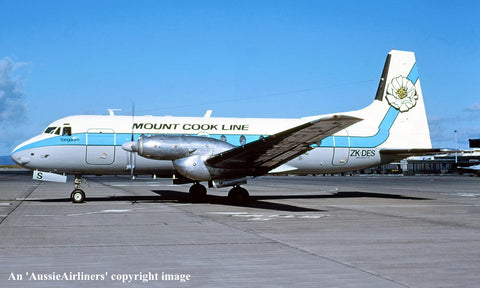
ZK-DES – Mount Cook Airline HS 748: The Story of Tongariro
For more than a quarter of a century, ZK-DES flew through one of the most spectacular aviation environments in the world.
New Zealand.
Mountains.
Glaciers.
Narrow valleys.
Remote communities.
And airports surrounded by landscapes that made flying there unlike almost anywhere else.
The aircraft was a Hawker Siddeley HS 748.
Its name was Tongariro.
Delivered new to Mount Cook Airline in 1971, ZK-DES became part of a fleet that helped connect New Zealand's growing tourism industry with destinations across both the North and South Islands.
Christchurch.
Queenstown.
Rotorua.
Auckland.
Wellington.
And numerous regional destinations.
But ZK-DES was more than simply another regional turboprop.
Its career represented an important period in New Zealand aviation.
The aircraft arrived when Mount Cook was expanding beyond its pioneering DC-3 operations.
It remained as Air New Zealand gradually took ownership of the airline.
It survived into the ATR era.
And after more than 26 years in New Zealand, it began an entirely new chapter on the other side of the world.
United Kingdom.
G-SOEI.
Emerald Airways.
And eventually N748D.
By the time the aircraft was finally dismantled, more than four decades had passed since its construction.
Today, part of the genuine fuselage skin from ZK-DES has been preserved by Aircrafttag.
Born as ZK-DES
The aircraft was built in Britain as a Hawker Siddeley HS 748 Series 2A/242.
Its manufacturer serial number was MSN 1689.
It was powered by two Rolls-Royce Dart 534-2 turboprop engines.
The aircraft was configured to carry approximately 50 passengers.
In 1971, the new HS 748 travelled halfway around the world to begin its working life.
Its customer was Mount Cook Airline.
Its registration became ZK-DES.
The aircraft was delivered new on 2 July 1971.
And it received a name closely connected with New Zealand itself.
Tongariro.
Tongariro
Mount Tongariro is one of New Zealand's most recognizable volcanic mountains.
Located in the central North Island, it forms part of Tongariro National Park together with Mount Ngauruhoe and Mount Ruapehu.
Naming ZK-DES Tongariro therefore fitted perfectly with the identity of Mount Cook Airline.
This was an airline whose history was deeply connected with the New Zealand landscape.
Mountains were not simply part of the airline's branding.
They were part of its operating environment.
And ZK-DES would spend most of its life flying above that landscape.
From Avro to Hawker Siddeley
The origins of the HS 748 stretched back to the 1950s.
British aircraft manufacturer Avro began developing a new regional airliner intended to serve the market traditionally occupied by aircraft such as the Douglas DC-3.
The challenge was significant.
The DC-3 had become one of the most successful transport aircraft ever built.
Airlines around the world needed a modern replacement.
Avro's answer was the Avro 748.
The prototype made its first flight in 1960.
But Avro was operating within a British aircraft industry undergoing major consolidation.
Avro became part of Hawker Siddeley.
As a result, the aircraft that began as the Avro 748 became widely known as the Hawker Siddeley HS 748.
The basic concept proved extremely successful.
A robust twin-engine turboprop.
Good short-field performance.
A strong airframe.
And the ability to operate reliably from regional airports.
Exactly the sort of aircraft Mount Cook needed.
Built for Difficult Airports
The HS 748 was not designed simply to fly between major international airports.
Its strength was versatility.
The aircraft could operate from relatively short runways and regional airports where larger aircraft were less practical.
Its two Rolls-Royce Dart engines were part of one of the most important turboprop engine families of the era.
The design also developed a reputation for structural strength and reliability.
These characteristics helped make the HS 748 successful in parts of the world where aviation infrastructure could be challenging.
For New Zealand, this mattered.
Mount Cook Airline's network included airports surrounded by mountains and difficult terrain.
The airline needed aircraft capable of operating reliably in exactly these environments.
The HS 748 became one of its defining aircraft.
Mount Cook Airline
The history behind Mount Cook Airline stretched much further back than ZK-DES.
Its roots were connected with aviation pioneer and tourism entrepreneur Rodolph Lysaght Wigley.
In 1920, Wigley established the New Zealand Aero Transport Company.
Commercial aviation was still in its infancy.
Passenger flying as we understand it today barely existed.
Yet the businesses developed by Wigley and his family would eventually evolve into an aviation operation closely connected with tourism in New Zealand's South Island.
After interruptions, restructuring and the Second World War, aviation activities were revived.
During the 1950s, Mount Cook Air Services emerged.
Then came scheduled passenger operations.
By the early 1960s, aircraft were connecting Christchurch, Mount Cook, Queenstown and other destinations.
The airline's Douglas DC-3s became part of New Zealand's developing tourist network.
But passenger demand was growing.
A newer aircraft was needed.
The HS 748 Arrives in New Zealand
Mount Cook introduced the HS 748 at the end of the 1960s.
The type would become central to the airline's regional operations.
For almost three decades, HS 748s served Mount Cook routes across New Zealand.
ZK-DES joined this operation in July 1971.
Contemporary photographs show the new aircraft flying over the Mount Cook region shortly after delivery.
The connection between aircraft, airline and landscape could hardly have been more appropriate.
A British-built turboprop named Tongariro.
Flying around New Zealand's highest mountains.
For an airline named Mount Cook.
Flying Through New Zealand
For the next two and a half decades, ZK-DES became part of everyday regional aviation in New Zealand.
The HS 748 fleet allowed Mount Cook to connect important tourist destinations and regional centres.
For passengers, the experience was very different from modern jet travel.
Two Rolls-Royce Dart turboprops dominated the soundscape.
Passengers boarded relatively close to the ground.
Flights often passed over some of New Zealand's most spectacular scenery.
Mountains.
Lakes.
Coastlines.
Volcanic landscapes.
ZK-DES was not carrying passengers above an anonymous landscape.
The landscape itself was part of the reason many of them were travelling.
Queenstown
One destination became particularly associated with Mount Cook Airline.
Queenstown.
Today, Queenstown is internationally known as one of New Zealand's most important tourism destinations.
Developing reliable air connections into the region was an important part of its growth.
Mount Cook had been deeply involved in that development.
The airline's aircraft became familiar sights at Queenstown Airport.
And ZK-DES was among them.
The HS 748 was particularly appropriate for regional operations of this kind.
By the early 1990s, Tongariro had already spent around twenty years flying for Mount Cook.
Yet its New Zealand career was still not finished.
A Long Way From Home
Although ZK-DES spent most of its career in New Zealand, its history also included operations much farther away.
In 1982, the aircraft travelled to Europe in connection with a short lease to SATA Air Açores.
For an aircraft normally associated with New Zealand regional flying, this was an extraordinary change of scenery.
From the mountains and lakes of New Zealand to the islands of the Azores.
The assignment demonstrated the versatility of the HS 748.
It was an aircraft capable of working in very different geographical environments.
But the overseas chapter was temporary.
New Zealand remained the aircraft's home.
Air New Zealand Enters the Story
While ZK-DES continued flying, the ownership of Mount Cook Airline was changing.
After the death of Sir Henry Wigley, Air New Zealand gradually increased its involvement in the Mount Cook Group.
By the early 1980s, Air New Zealand had acquired a significant stake.
Its ownership increased further during the decade.
In 1991, Air New Zealand acquired the remaining shares.
Mount Cook Airline became a wholly owned Air New Zealand subsidiary.
For ZK-DES, everyday flying continued.
But the aircraft was now operating within a much larger airline group.
Mount Cook services became increasingly integrated into Air New Zealand's regional network.
The Mount Cook name nevertheless continued for many years after the 1991 takeover.
The End of the HS 748 Era
By the 1990s, the HS 748 was ageing.
The basic design dated back to another generation of aviation.
New regional aircraft offered better economics, modern cabins and more advanced technology.
Mount Cook needed a replacement.
The airline selected the ATR 72.
The first ATR 72s arrived during the mid-1990s.
Gradually, the new Franco-Italian turboprops replaced the HS 748 fleet.
For aircraft such as ZK-DES, the transition marked the end of an extraordinary period.
Mount Cook had operated HS 748s for almost thirty years.
They had helped build the airline's regional network.
They had carried tourists through some of the world's most dramatic landscapes.
But their time in New Zealand was ending.
Tongariro Retires
ZK-DES was withdrawn from Mount Cook service during the transition to the ATR fleet.
Yet the aircraft did not immediately leave New Zealand.
By 1997, it was stored at Christchurch after retirement.
More than 26 years had passed since its delivery.
The name Tongariro was still inseparably connected with the aircraft.
Its New Zealand chapter was finally over.
But unlike many aircraft retired after such a long career, MSN 1689 would fly again.
Its next destination was almost as far away from New Zealand as possible.
Britain.
From ZK-DES to G-SOEI
In February 1998, the former Mount Cook aircraft was registered in the United Kingdom.
Its new registration was:
G-SOEI.
Its new operator became Emerald Airways.
This was a dramatic change.
For decades, the aircraft had flown regional routes through New Zealand.
Now it was back in the country where it had originally been built.
The HS 748 was well suited to Emerald Airways' type of operation.
The British carrier became particularly associated with freight and charter flying.
The aircraft's robust design and proven reliability made the type useful even decades after it had first entered service.
MSN 1689 had found a second life.
Back in Britain
The former ZK-DES continued operating in Europe as G-SOEI.
By now, the aircraft was already approaching thirty years old.
Yet the HS 748 had earned a reputation for durability.
Aircraft of the type continued working long after newer designs had replaced them in mainstream passenger operations.
G-SOEI became part of that story.
Its days of carrying tourists between New Zealand destinations were over.
But its aviation career continued.
Then Emerald Airways itself ran into difficulty.
The airline ceased operations in 2006.
Once again, MSN 1689 faced an uncertain future.
Stored at Blackpool
Following the end of Emerald Airways operations, G-SOEI was stored at Blackpool.
The aircraft that had once crossed New Zealand daily now sat on the ground in northern England.
For many old turboprops, this would have been the final stage before dismantling.
But the former Tongariro still had another identity ahead.
In 2009, the British registration was cancelled.
MSN 1689 became:
N748D.
An American registration on a British-built aircraft that had spent most of its life in New Zealand.
Its identity had become truly international.
ZK-DES.
G-SOEI.
N748D.
Three registrations.
One aircraft.
N748D
Under its new registration, the aircraft was moved to Southend.
By this stage, its days as a regular commercial passenger aircraft were long behind it.
But remarkably, the physical airframe continued to survive.
Years passed.
The HS 748 became increasingly rare.
The aircraft that had once represented modern regional aviation had become a survivor from another era.
Then came one final visual identity.
5Y-CHD
During its final years, the former ZK-DES was also seen carrying the markings 5Y-CHD.
The Kenyan identity suggested another possible chapter for the ageing turboprop.
But there would be no long new commercial career.
By this point, MSN 1689 was around 46 years old.
The aircraft that had begun flying for Mount Cook in 1971 had reached the end.
It was eventually dismantled in 2017.
The complete aircraft disappeared.
But part of Tongariro survived.
From ZK-DES to Aircrafttag
Part of the genuine fuselage skin of Mount Cook Airline HS 748 ZK-DES was preserved and transformed by Aircrafttag into collectible pieces of aviation history.
This material represents an unusually long aviation story.
It comes from an aircraft built in 1971.
An aircraft that spent more than a quarter of a century flying in New Zealand.
An aircraft named Tongariro.
An aircraft connected with one of the most historic names in New Zealand tourism and regional aviation.
Its aluminium experienced decades of real operations.
New Zealand summers.
Cold winters.
Rain.
Mountain weather.
Coastal conditions.
Thousands of flights.
Ground handling.
Maintenance.
And countless journeys across one of the world's most spectacular countries.
Original scratches, marks, paint variations and traces of service can remain visible.
They are not imperfections added later.
They belong to the actual aircraft.
ZK-DES. G-SOEI. N748D.
Three registrations describe three very different stages of MSN 1689.
ZK-DES represents New Zealand.
Mount Cook Airline.
Tongariro.
Queenstown.
Christchurch.
And more than 26 years of regional aviation.
G-SOEI represents Britain.
Emerald Airways.
A second commercial life for an aircraft already decades old.
N748D represents the final chapter.
An ageing HS 748 surviving long after most aircraft of its generation had disappeared.
But one registration defines the aircraft more than any other.
ZK-DES.
Because New Zealand was where MSN 1689 spent the overwhelming majority of its operational life.
The Aircraft Named Tongariro
ZK-DES did not become famous because of a dramatic accident.
It did not carry the colours of one of the world's largest airlines.
Its importance comes from something different.
Longevity.
Regional aviation.
And its connection with a unique airline and country.
For more than 26 years, this HS 748 helped connect New Zealand.
It flew through landscapes that attracted travellers from around the world.
It carried the name of one of the country's most famous mountains.
And it became part of Mount Cook Airline's long relationship with the HS 748.
The aircraft then travelled to Britain and continued surviving for years after its New Zealand career had ended.
By the time MSN 1689 finally disappeared, approximately 46 years had passed since its construction.
The complete aircraft no longer exists.
But part of ZK-DES does.
Preserved by Aircrafttag, genuine fuselage skin from Tongariro provides a physical connection to Mount Cook Airline, the Hawker Siddeley HS 748 and more than a quarter-century of New Zealand aviation history.
.